Importing Pet Treats for Wholesale: A Distributor’s Pre-Order Checklist
Importing pet treats can be an attractive way to expand a distribution business.
But purchasing branded dog treats or cat snacks from an overseas supplier involves more than agreeing on a wholesale price.
Before products reach retail shelves, importers may need to consider ingredient restrictions, product documentation, labeling, shipping arrangements, customs procedures, and local market requirements.
Even a commercially appealing product can become difficult to sell if the importer overlooks these details.
For businesses planning to import wholesale pet treats, a structured pre-order checklist helps reduce avoidable costs and improve launch preparation.
This guide covers ten areas that distributors and pet retailers should review before placing their first wholesale order.

1. Confirm That the Product Fits Your Local Market
The first question is not how many cartons to order.
It is whether the selected products are suitable for your retail customers.
A distributor serving independent pet stores may need a different assortment from a business supplying supermarkets or online marketplaces.
Before selecting products, consider:
- Dog and cat ownership patterns in the target market
- Commonly purchased treat formats
- Customer price expectations
- Preferred pack sizes
- Local retail channels
- Competing brands and products
For example, small training rewards may be relevant to stores serving active dog owners.
Chew treats may serve customers looking for longer chewing occasions, while freeze-dried meat treats can support ingredient-focused retail positioning.
Cat treats can provide an additional category for stores selling both dog and cat products.
A balanced assortment is generally more useful than choosing products solely because they have a low purchase price.

2. Check Product Categories and Ingredient Information
Different pet treat products may have different sourcing and import considerations.
Common categories include:
Dog Training Treats
These are typically smaller, portionable rewards used during training or everyday interactions.
Important buying considerations include piece size, texture, ingredient composition, and packaging format.
Explore Pack’n Pride Dog Training Rewards to see available product styles.
Dog Chews
Chew products can differ significantly in their raw materials, structure, and intended chewing experience.
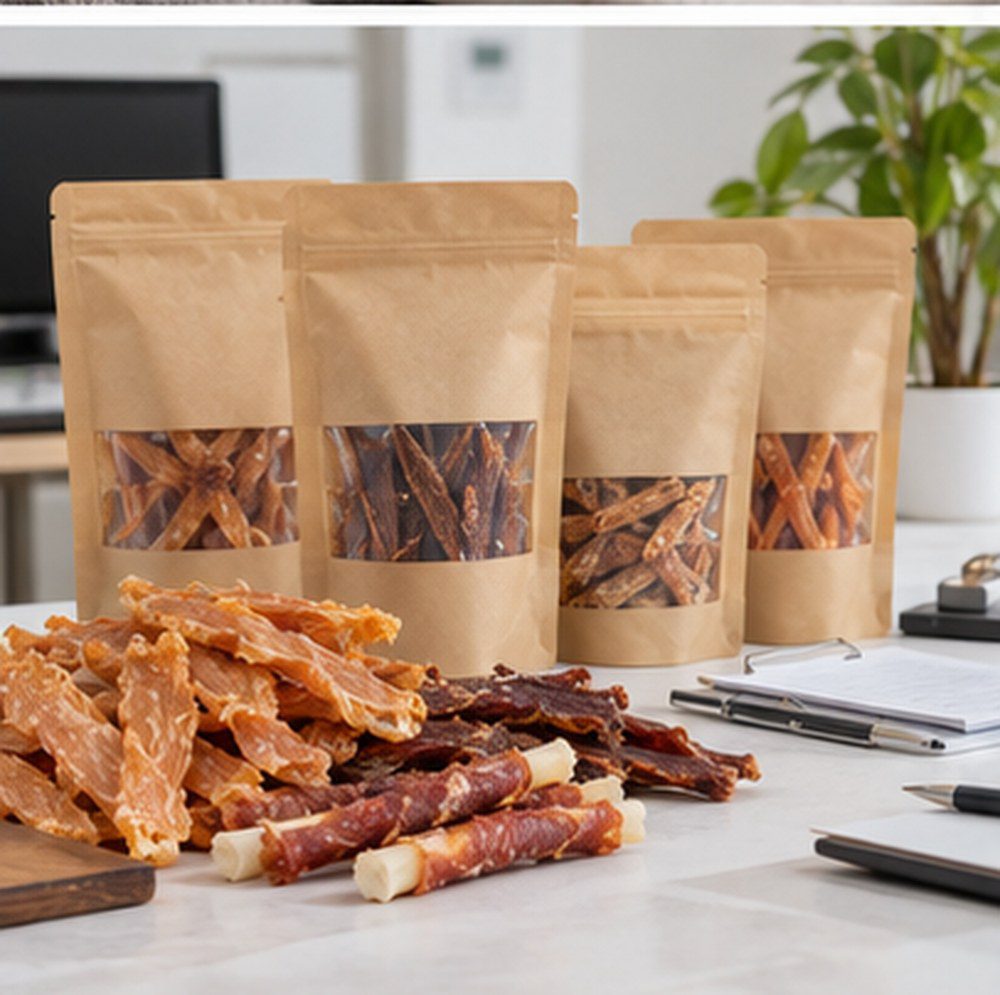
Pack’n Pride offers branded chew treats, including chicken- and duck-based formats.
See the Pack’n Pride Born to Chew range.
Freeze-Dried Treats
Freeze-dried products require attention to moisture protection, product integrity, and ingredient labeling.
Importers should review packaging suitability and handling requirements.
Cat Cream Treats
Creamy cat snacks have different packaging and product characteristics from dry treats.
Pack’n Pride offers individual cat cream products in flavors such as chicken with goat milk and tuna with scallop.
Explore the Pack’n Pride Cat Cream range.
Each category should be evaluated against the intended destination market before ordering.

3. Verify Import Eligibility Before Paying a Deposit
Pet treats containing animal-derived ingredients may be subject to veterinary or animal-health import controls.
Requirements depend on the destination country, ingredient origin, product processing, and classification.
Importing Pet Treats Into the United States
U.S. importers should check applicable requirements administered by the Food and Drug Administration (FDA).
Depending on the product and transaction, these may include food facility registration, prior notice, labeling requirements, and Foreign Supplier Verification Program obligations.
Animal-origin materials may also be subject to USDA Animal and Plant Health Inspection Service requirements.
Relevant official guidance is available from the FDA: Importing Animal Food.
Importers should confirm the requirements for each specific product rather than assuming all pet treats are treated identically.
Importing Pet Treats Into the European Union
EU import requirements may include country and establishment eligibility, veterinary documentation, border controls, and relevant feed labeling rules.
Some animal-derived pet food products are subject to requirements under EU animal by-product legislation.
Importers should confirm whether the selected products require checks at an approved Border Control Post and the relevant documentation.
Review the European Commission’s animal product import guidance.
Other Markets
Countries in Southeast Asia, South America, the Middle East, and other regions may have their own registration, labeling, ingredient, and import approval requirements.
A distributor should work with an experienced customs broker or qualified regulatory specialist before confirming the shipment.
Important: A supplier’s existing export experience does not automatically guarantee that a specific product is eligible for import into every destination country.
4. Request the Necessary Product Documents
A professional importer should request suitable product information before finalizing a purchase.
Depending on the product and destination market, documents may include:

| Document | Purpose |
|---|---|
| Product specification | Defines the product and key quality parameters |
| Ingredient list | Supports formula review and labeling |
| Analytical composition | Provides relevant nutritional information |
| Certificate of Analysis | Reports specified test results for a batch or sample |
| Shelf-life information | Supports inventory and storage planning |
| Packaging specification | Confirms pack dimensions, materials and weights |
| Applicable certificates | Supports required veterinary or regulatory procedures |
| Commercial invoice and packing list | Supports shipment and customs processing |
The exact document package must be confirmed for the market and shipment.
Distributors should also check whether labels, certificates, and commercial documents use consistent product names and descriptions.
A mismatch can create unnecessary questions during customs clearance or retailer onboarding.
5. Review Retail Packaging and Labeling
A product may be well suited to consumers but still require additional work before it can enter a particular market.
Pet treat labels may need to include relevant information such as:
- Product identity
- Intended animal species
- Net quantity
- Ingredients
- Feeding guidance
- Appropriate warnings
- Batch or lot identification
- Best-before date or other required durability information
- Manufacturer, importer, or distributor identification
Required wording and format vary by jurisdiction.
Importers should also confirm whether local-language labeling is necessary.
When sourcing Pack’n Pride branded products, buyers should review the existing packaging and discuss applicable market requirements before ordering.
The objective is to distribute genuine Pack’n Pride branded products with appropriate market documentation—not to create a separate private label product.

6. Calculate the Total Landed Cost
The wholesale unit price is only one part of the total cost of importing pet treats.
Other expenses may include freight, insurance, customs duties, handling charges, veterinary checks where applicable, warehousing, and local delivery.
A practical formula is:
Landed Cost = Product Purchase Cost + Freight + Insurance + Duties + Applicable Non-Recoverable Taxes + Import and Handling Expenses
The exact treatment of taxes and other costs depends on the transaction and local accounting rules.
Consider this hypothetical shipment.
| Cost Item | Illustrative Amount |
|---|---|
| Product purchase | $5,000 |
| Freight | $700 |
| Insurance | $50 |
| Customs duties | $300 |
| Other import and handling costs | $450 |
| Total landed cost | $6,500 |
If the shipment contains 2,000 retail packs, the illustrative landed cost is:
$6,500 ÷ 2,000 = $3.25 per pack
This excludes downstream distribution overheads unless those costs have already been included.
A distributor can use the result to estimate viable wholesale selling prices and retailer margins.
Before comparing quotes from different suppliers, confirm the agreed Incoterm and which costs are included.
7. Check Minimum Order Quantity and Packaging Configuration
MOQ is important, but a single minimum order number does not tell the whole story.
Buyers should ask about the minimum quantity per product and the carton configuration.
For example, determine whether:
- Different product categories can be combined in one shipment
- Individual SKUs have separate order minimums
- Multipacks are already configured for retail
- Master carton quantities are fixed
- Mixed pallets can be arranged
- Reorder quantities differ from opening quantities
An assortment that looks affordable at the product level may require more inventory investment than expected if each SKU has a substantial minimum.
For new distributors, choosing fewer products with realistic reorder potential can be more effective than launching an oversized range.
Pack’n Pride wholesale customers should request current category availability, packaging information, and commercial terms directly.
8. Confirm Shelf Life and Storage Requirements
Pet treat shelf life affects the financial risk of an imported shipment.
International transit, customs processing, distribution, and retailer storage all consume part of the product’s remaining shelf life.
Before ordering, confirm:
- Total validated shelf life
- Shelf life remaining at dispatch
- Storage requirements
- Packaging integrity requirements
- Lot coding
- Stock rotation procedures
- Product-specific handling instructions

For example, freeze-dried treats may require particular attention to moisture protection.
Soft treats and wet products may have different packaging and processing requirements.
These details should be reviewed separately for each product category.
Importers should also define an acceptable minimum remaining shelf life when goods are received.
9. Discuss Distribution Terms and Sales Channels
A successful distribution arrangement needs clear commercial expectations.
Before launching a new brand in a country or region, clarify which sales channels are intended.
These may include:
- Independent pet stores
- Regional retail chains
- Pet specialty wholesalers
- E-commerce retailers
- Supermarket pet departments
Commercial discussions should address pricing, payment terms, geographic scope, marketing materials, and reorder arrangements.
Any rights relating to territories, exclusivity, or use of brand assets should be agreed upon expressly rather than assumed.
For businesses interested in selling Pack’n Pride, the cooperation model is based on distributing the existing Pack’n Pride brand.
The products retain their branded identity while local distributors develop appropriate sales channels.
10. Plan Your First Shipment and Reorder Strategy
A first order should generate useful commercial information.
Instead of focusing only on initial shipment value, distributors should monitor how the products perform after they reach stores.
Important metrics include sell-through, inventory turnover, repeat orders, and product-level margins.
A simple reorder calculation can help.
Reorder Point = Expected Demand During Replenishment Lead Time + Safety Stock
For example, suppose a product sells approximately 100 packs per week and total replenishment lead time is six weeks.
Expected demand during replenishment is 600 packs.
If the distributor chooses a safety stock of 150 packs, the initial planning reorder point would be:
600 + 150 = 750 packs
This is only a planning example. Actual demand variability and service requirements should determine the appropriate safety stock.
The objective is to keep successful products available without accumulating unnecessary inventory.
Why Consider Pack’n Pride for Branded Pet Treat Distribution?
Pack’n Pride offers a range of branded pet treats and food products designed to serve different pet ownership and retail purchasing needs.
Our product categories include:
- Dog training rewards
- Dog chew treats
- Freeze-dried pet treats
- Meat-based dog snacks
- Cat cream treats
- Selected dog and cat wet food products
For distributors, this range provides opportunities to evaluate complementary product categories under one consumer brand.
We welcome discussions with qualified importers, wholesalers, and retailers interested in developing Pack’n Pride distribution in their markets.
Buyers can review the Pack’n Pride product range and contact our team regarding available products and commercial cooperation.
Frequently Asked Questions
Can I import pet treats without checking local regulations?
No. Import requirements depend on product composition and destination-market rules. Buyers should confirm applicable requirements before purchasing or shipping.
What should I request from a pet treat supplier before ordering?
Start with product specifications, ingredient information, packaging details, shelf-life information, and the documents relevant to the destination market.
Can distributors order several Pack’n Pride product categories?
Interested distributors can discuss a mixed category assortment with Pack’n Pride. Availability and order conditions require confirmation.
Are Pack’n Pride products available for branded wholesale resale?
Pack’n Pride offers branded pet treats and foods. Businesses interested in distribution can contact the team to discuss current product availability and potential cooperation.
How can I reduce the risk of my first pet treat import order?
Check import eligibility, request product documents, calculate landed costs, evaluate shelf life, confirm commercial terms, and begin with an assortment appropriate for your sales channels.
Conclusion: Prepare for a Sustainable Distribution Business
Importing branded pet treats can help distributors expand their retail portfolios and serve new customer needs.
However, product quality, documentation, commercial planning, and inventory management all contribute to a successful import project.
By completing the right checks before ordering, businesses can reduce uncertainty and develop a more sustainable distribution strategy.
Interested in bringing Pack’n Pride pet treats to your market?
Contact Pack’n Pride to explore branded wholesale and distribution opportunities.
Please include your country, company name, existing sales channels, and the pet treat categories you want to distribute.
Our team can discuss the available product range and potential next steps for your market.