
Wholesale Dog Training Treats: How Retailers Can Build a More Useful Range
A customer looking for training treats usually has a specific job in mind: rewarding a recall, practicing a new cue or keeping a dog engaged during a walk. A shelf organized only by flavor does not always help that customer choose.
For retailers buying wholesale dog training treats, the useful starting point is the reward experience. How easy is the product to carry, portion and offer? What information does the customer need before buying? And does each item contribute something distinct to the range?
A focused assortment can make those questions easier to answer. Here is a practical framework for selecting branded training treats and reviewing how they perform in your store or online catalog.
Define the Shopping Mission Before Selecting Flavors
Start with the questions customers already ask your staff. Some want small, ready-to-use rewards. Others want a product they can divide into portions. Some are checking the full ingredient list before choosing a familiar recipe.
Build your buying brief around these needs rather than assuming that more flavors always create a stronger range.
For each proposed SKU, write one sentence explaining its role. For example: “An option for customers who want conveniently portioned rewards during a walk.” Verify that the actual product supports that description before using it on a shelf label or product page.
If two items serve the same shopper, at the same price point, with no clear difference your staff can explain, consider whether both need to be in the opening order.
Compare Formats with Actual Samples
Product photography helps communicate shape, but it does not answer every buying question. Review samples and confirm the details that affect everyday use.
Check piece dimensions, consistency, handling and the packaging closure. Where a product is intended to be divided, evaluate whether it portions as expected. Observe crumbs or residue during normal handling rather than making an assumption from the product name.
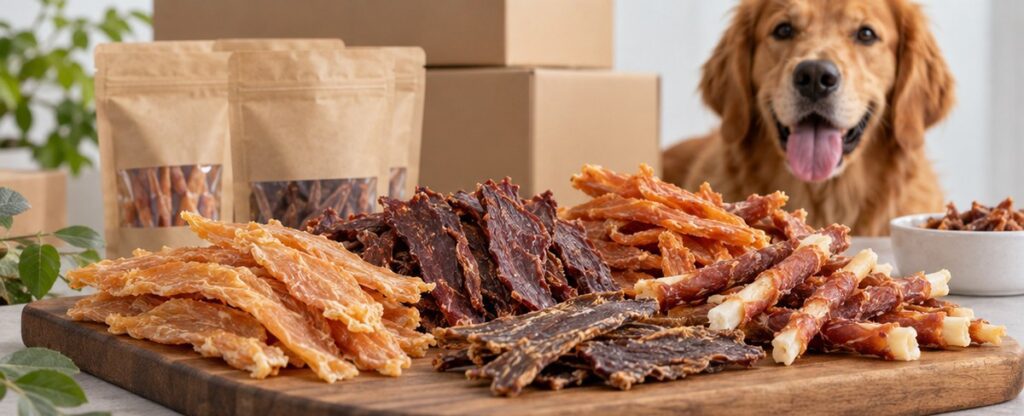
Pack’n Pride’s Training Rewards range includes bites, sausage and roll formats. Use the current catalog and samples to establish which products fit your market and which details should appear in your retail listings.
| Buying question | What to review |
|---|---|
| Is the portion practical? | Actual piece size and any portioning instructions |
| Is the product easy to carry? | Pack size, closure and normal handling |
| Can staff explain the recipe? | Full ingredient declaration and approved product wording |
| Can customers compare value? | Net weight, selling price and verified pack information |
| Does the SKU deserve shelf space? | A clear role within the existing assortment |
Make Product Information Easy to Compare

Give training-treat listings a consistent structure. Customers should not have to open several tabs to find the net weight on one item and the ingredients on another.
Use the approved product information to show the recipe name, ingredients, pack weight, feeding directions and storage instructions. Include calorie information when it is supplied and applicable; do not estimate calories per piece from appearance.
Likewise, avoid interpreting a named meat ingredient as evidence that the recipe contains only that animal protein. Check the full declaration before adding filters or descriptions such as “single protein.”
For an example of a specific product to review within the range, see Pack’n Pride Chicken & Flaxseed Bites. Confirm the current specification and availability before incorporating a SKU into your purchasing plan.
Plan the First Order Around Learning
An opening order should help you discover which products fit your customers without spreading stock too thinly across similar items.
Choose a manageable shortlist and ask for the available wholesale terms, case quantities and replenishment schedule. Assign a reason for stocking each item, then decide what evidence would justify a larger reorder.
As an illustrative approach, a retailer might begin with one core reward format, one alternative recipe and one different format. This is a planning example, not a prescribed Pack’n Pride bundle or a guarantee that a mixed case is available.
Base quantities on your own customer traffic, sales history and storage capacity. A format that performs well in a training-focused shop may need a different introduction in a general pet store.
Connect the Display to the Customer’s Routine
Help shoppers understand where training rewards fit into their day. A clear category label, a concise format description and an accessible ingredient list are often more useful than a long list of broad claims.
In a physical store, consider positioning the range where customers can also find walking or training accessories. Online, connect relevant product categories and make pack information visible near the purchase decision.
Keep staff guidance specific: explain the format, point out the feeding directions and help customers compare the available choices. Avoid promises about training outcomes that the product itself cannot establish.
Review Reorders with More Than Sales Revenue
Track units sold, gross margin, remaining stock and customer feedback for each SKU. Record stockouts as well: a product cannot sell while unavailable, so low recorded sales may not reflect low interest.

Review whether customers understand the differences between items. Repeated questions about size or ingredients may point to a listing problem rather than a product problem.
Use those findings to refine the range. Add depth to products with a clear role and consistent demand, and reconsider items that duplicate existing choices without attracting their own customers.
Frequently Asked Questions
How many training-treat SKUs should a retailer start with?
There is no universal number. Start with a range your staff can explain and your inventory budget can support. Expand when sales and customer feedback identify a useful gap.
Should every flavor have the same opening quantity?
Not necessarily. Use your store’s history and customer preferences to guide quantities, then confirm what the supplier’s case structure allows.
What should I include in a wholesale inquiry?
Provide your country, business type, sales channels, preferred products and estimated opening order. Ask about current availability, case quantities, pricing and replenishment terms.
Explore Pack’n Pride for Your Retail Training-Treat Range
Looking to introduce Pack’n Pride products to your store or distribution network? Contact Pack’n Pride for wholesale pricing and share your market, retail channels and training-treat shortlist.
Request the current catalog and product details so you can build a branded assortment with a clear purpose for every SKU.