A pet shop buyer replies, “We’ll take two of the chicken.” Before a distributor can book that sale, someone has to work out which chicken treat the buyer meant and whether “two” means pouches or cases. A pet treat line sheet gives each orderable item its own row. The buyer can choose a product, see the cost of the case and send back a quantity the warehouse can pick.
Choose the products the buyer actually discussed
If a store asked for small dog rewards, send a shortlist it can put on that shelf. Retain the brand’s full product name, the retail pack weight and a front image for the market you supply. Chicken Roll and Chicken Sausage deserve separate rows even when they sit side by side in the same Pack’n Pride Training Rewards range.
Two Pack’n Pride listings show why a single line labeled “chicken treats” leaves room for error. A buyer comparing these products can distinguish the format and size immediately. Add local case and pricing details from a current quote before sending an order sheet.
| Branded retail item | Retail pack | Buyer’s reference |
|---|---|---|
| Training and Rewards Chicken Roll | 85 g | Chicken roll |
| Chick Chick Hooray Fillet | 100 g | Chicken fillet |
Separate the shelf unit from the order unit
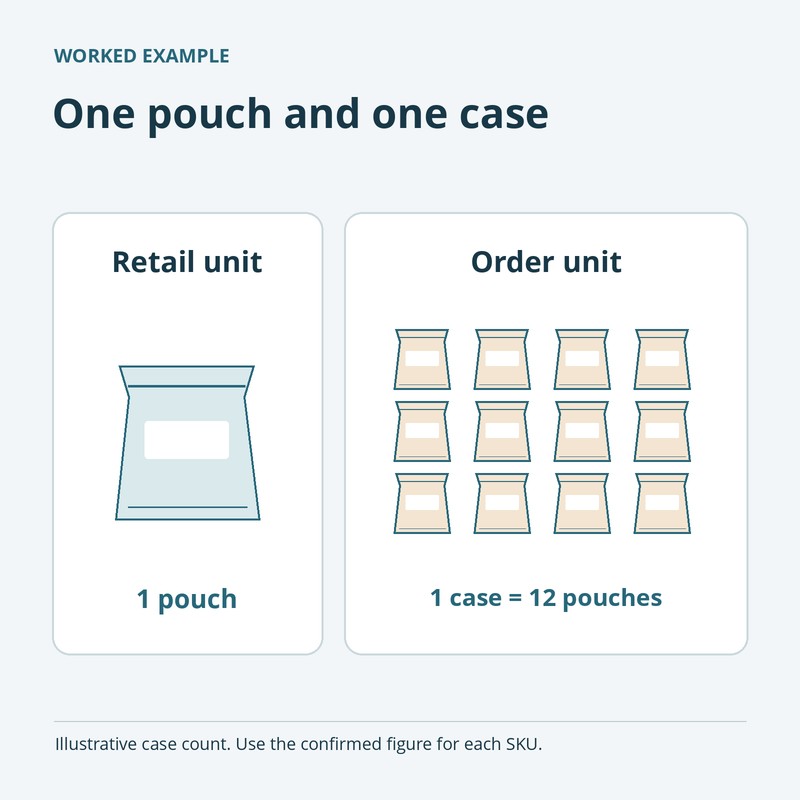
The shelf unit is the sealed pack the shopper buys. The order unit is what the retailer buys from the distributor. If orders ship by full case, label the quantity column “cases requested.” List the number of retail packs inside each case on the same row. Where a mixed case is offered, give it its own row with the exact contents the buyer will receive.
Take a buyer who wants six chicken pouches and six duck pouches for a first display. Two single-flavor cases of twelve would deliver twice the planned number of pouches. A mixed case containing six of each would meet the request if that configuration is available. Show its contents explicitly and confirm whether the same mix can be reordered. If the store can order only full single-flavor cases, it can decide whether to start with one flavor or share a case across branches. The actual case terms belong next to the item the buyer selects.
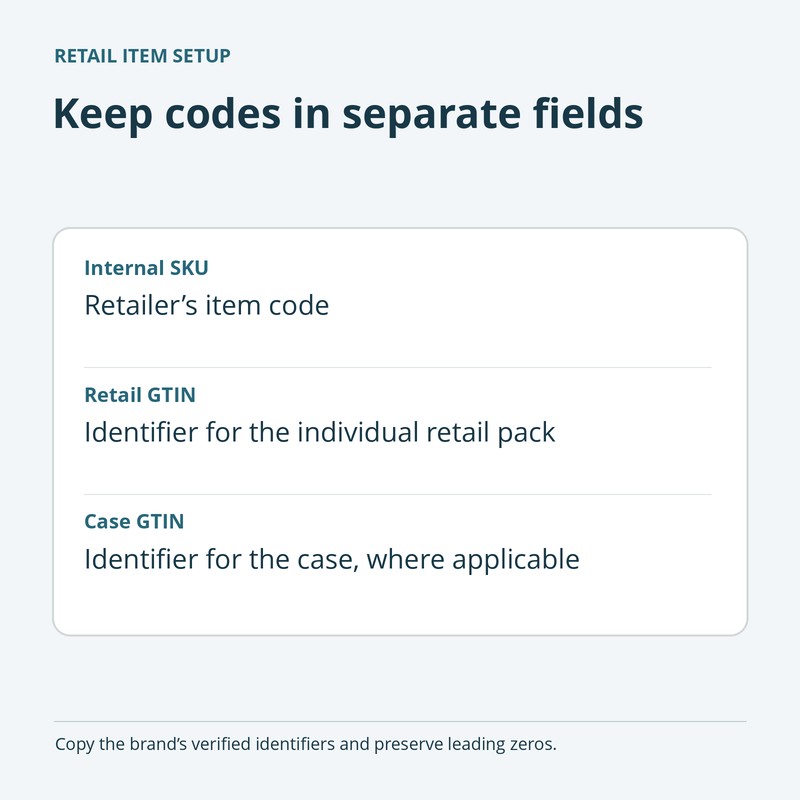
Keep the retailer’s item code, the retail pack’s Global Trade Item Number (GTIN) and any applicable case GTIN in clearly named fields. Preserve leading zeros when moving identifiers between spreadsheets. Confirm each number against the current packaging or the brand’s item data. For the difference between a retail unit, an inner pack and a case, see GS1’s guide to packaging levels.
Try the sheet at the receiving desk
Give a colleague one sealed pouch, its outer carton and a draft line sheet. Ask them to identify the retail item, find the unit they would order and tell you how many pouches the store receives for a quantity of one. Watch which column they use. If they reach for the number on the pouch when asked for the carton identifier, move the packaging level into the column heading. This quick check catches ambiguity while you can still fix it in a single file.
Then look at the photo on a phone. If two flavors have similar packaging, the product name and net weight should remain readable in the row even when the image is small. Give each linked product image a filename that includes the item name or code. A buyer who saves three files called “chicken front” will have to reopen them all when the online store asks which image belongs to which listing.
Let the store price its opening order
Put the currency and price basis next to the amount. A buyer ordering by case needs a case price. A store that works backwards from a shelf price will also want the cost per retail pack. State whether delivery or taxes are included and when the quote expires. Keep a suggested retail price in a separately labeled field if you supply one for that market.
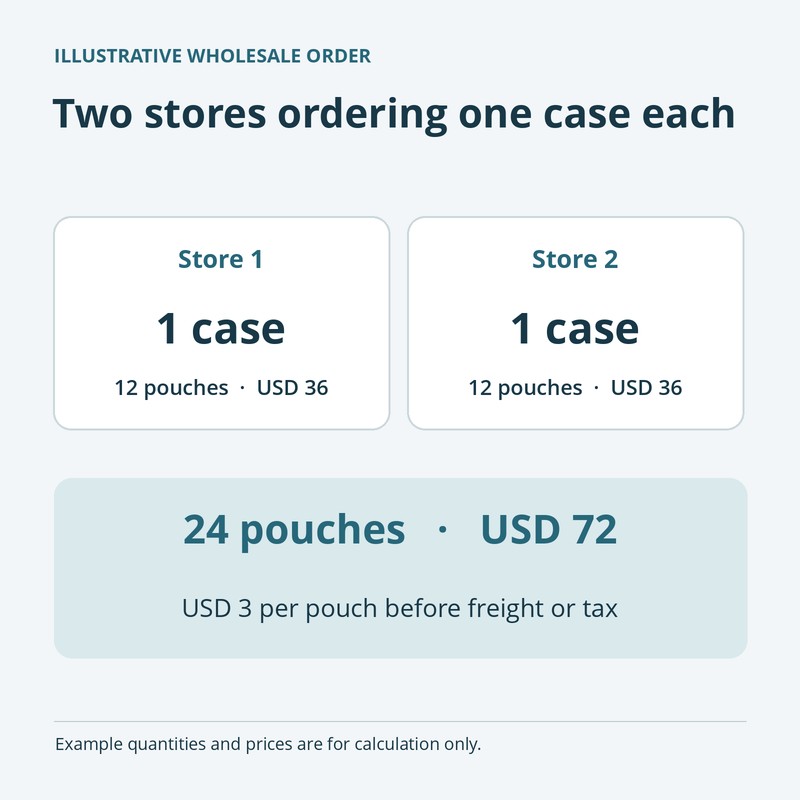
Consider an illustrative case containing 12 pouches at a wholesale price of USD 36 per case. The store’s cost is USD 3 per pouch before freight or tax. If it wants a case for each of two branches, its order is two cases, 24 pouches and USD 72 in goods. These figures illustrate the arithmetic. Ask for the quoted case configuration and price for each Pack’n Pride item.
Freight can change the buyer’s view of the same order. Suppose both example cases ship together and the delivery charge is USD 12. The two cases now cost USD 84 delivered, or USD 3.50 per pouch before tax. At an illustrative shelf price of USD 5 before tax, that leaves USD 1.50 per pouch before other costs, a gross margin of 30% on the selling price when freight is included in cost. Show freight once in the calculation. A buyer who adds it again to an already delivered price will underestimate the margin.
For a chain, ask whether the buyer raises one purchase order for a central warehouse or a separate order for each store. Two cases on one line might be enough for a warehouse delivery. A split delivery also needs a branch allocation, delivery address and any separate freight charge. Once those details are recorded, the buyer can see whether the order minimum applies to the combined shipment or individually to each destination. Confirm the supplier’s answer before quoting a delivered total.
Make the line sheet easy to turn into a purchase order
Put the destination market, price list date and sales contact at the top. Give each row space for a case quantity and an extended amount. Add the opening order minimum and reorder terms where they apply, including whether the minimum covers one SKU or the whole order. A minimum of three cases across the range is a different buying decision from three cases of every flavor.
Link the current product sheet for ingredients, feeding directions and pack images. An online retailer may need a back panel image in addition to the front. If artwork or case contents change, date the revision, identify the affected SKU and tell buyers which version their next shipment will contain. That prevents a store from advertising the previous pack after a reorder.
Show what can ship for the planned shelf date
A launch date refers to the day a store wants the item on its shelf. The dispatch date on a supplier quote refers to when the goods can leave the warehouse. Give those dates distinct fields if timing matters to the order. For a product still awaiting a confirmed date, name the SKU and mark its availability as pending. The buyer can then decide whether to hold the full order, take an available line first or request a revised quote for the later shipment.
Before sending the file, try reading the buyer’s reply aloud using one completed row. It should identify the exact treat and pack weight, the number of cases, the agreed price basis and the delivery point. If the customer writes “two of the chicken” after reading it, the sales contact can reply with a specific confirmation line. That gives the retailer and the person booking the order the same written description to refer to later.
Request item data for your market
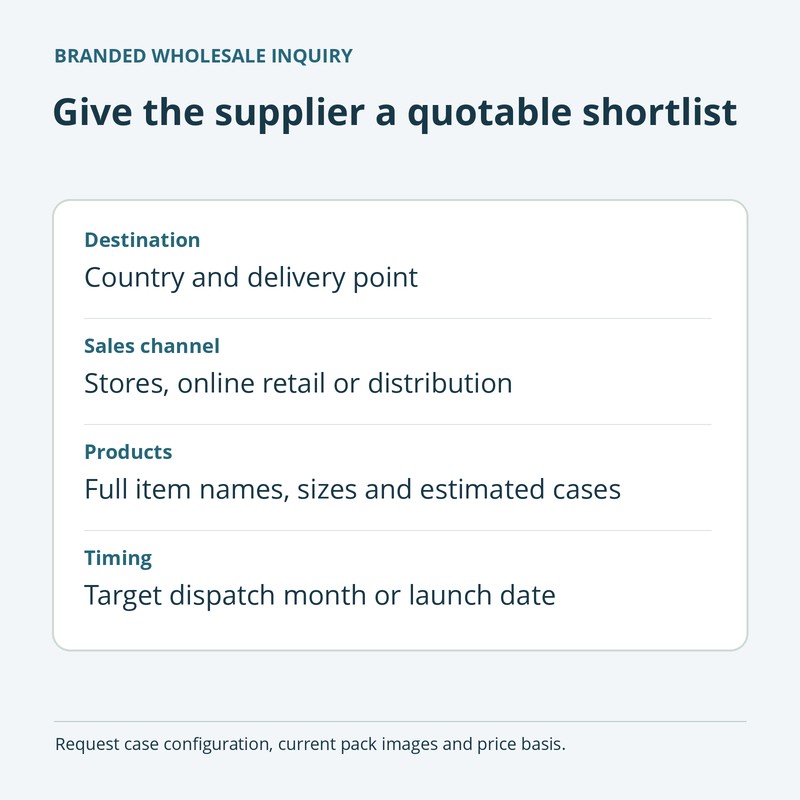
A useful first message is simple. “We supply six independent pet shops in [country]. Please quote Chicken Roll and Chick Chick Hooray Fillet by case and confirm retail pack sizes, case counts, available pack images and the earliest dispatch date for [month].” Add whether orders ship to one warehouse or directly to stores. That detail affects what you need to show each buyer.
Send the shortlist, sales channel and estimated opening quantities when you ask Pack’n Pride for a wholesale quote. Once the case count and price are confirmed, the buyer can return an order in the same units your team will ship.